What Will Happen to Humans When the Sun Dies
What Will Happen to Earth When the Sun Dies?
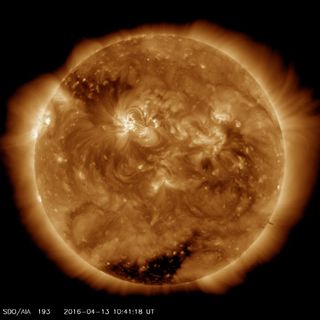
Stars are built-in, they live, and they die. The dominicus is no dissimilar, and when the lord's day dies, the Earth goes with information technology. But our planet won't go quietly into the night.
Rather, when the dominicus expands into a red giant during the throes of expiry, it will vaporize the Earth.
Perhaps not the story you were hoping for, only there's no demand to start ownership star-death insurance yet. The time scale is long — 7 billion or 8 billion years from now, at least. Humans take been around only about 40-thousandth that amount of time; if the age of the Earth were compressed into a 24-hour twenty-four hour period, humans would occupy only the final second, at most. If contemplating stellar lifetimes does nothing else, information technology should underscore the existential insignificance of our lives. [What If Globe Were Twice equally Big?]
And then what happens when the sun goes out? The answer has to do with how the dominicus shines. Stars begin their lives as large agglomerations of gas, by and large hydrogen with a nuance of helium and other elements. Gas has mass, so if you put a lot of it in one identify, information technology collapses in on itself under its own weight. That creates pressure on the interior of the proto-star, which heats up the gas until it gets so hot that the electrons get stripped off the atoms and the gas becomes charged, or ionized (a country chosen a plasma). The hydrogen atoms, each containing a single proton, fuse with other hydrogen atoms to become helium, which has two protons and two neutrons. The fusion releases energy in the course of light and estrus, which creates outward pressure, and stops the gas from collapsing any farther. A star is born (with apologies to Barbra Streisand).
There's enough hydrogen to proceed this process going for billions of years. But eventually, almost all of the hydrogen in the dominicus's core will have fused into helium. At that point, the sun won't be able to generate every bit much energy, and volition kickoff to collapse under its own weight. That weight can't generate plenty pressure level to fuse the helium as it did with the hydrogen at the outset of the star's life. Simply what hydrogen is left on the cadre'due south surface wil fuse, generating a little additional energy and allowing the sun to go on shining.
That helium core, though, will beginning to collapse in on itself. When it does, it releases energy, though not through fusion. Instead it merely heats upwards because of increased pressure (compressing any gas increases its temperature). That release of energy results in more low-cal and heat, making the lord's day even brighter. On a darker note, however, the energy as well causes the sun to bloat into a red giant. Red giants are ruby-red because their surface temperatures are lower than stars like the sun. All the same, they are much bigger than their hotter counterparts.
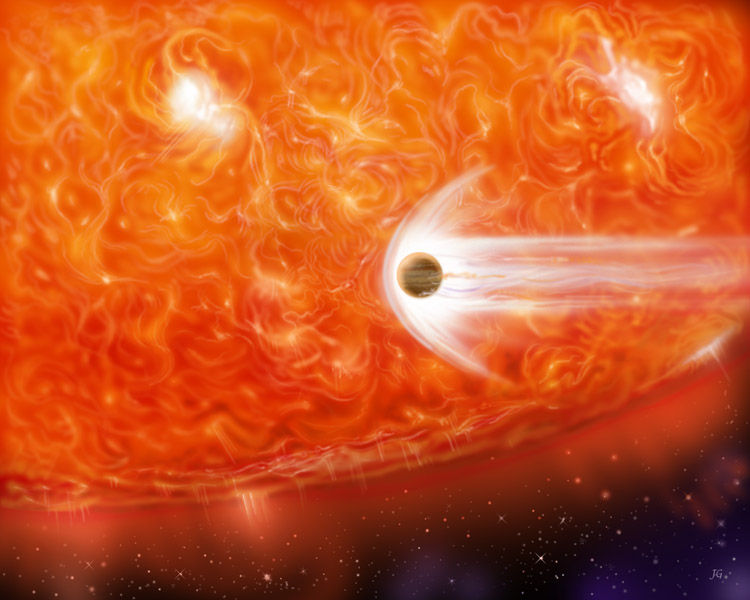
A 2008 report by astronomers Klaus-Peter Schröder and Robert Connon Smith estimated that the sun will get so large that its outermost surface layers will reach about 108 million miles (about 170 million kilometers) out, arresting the planets Mercury, Venus and Earth. The whole process of turning into a scarlet giant will take almost v meg years, a relative blip in the sun's lifetime. [50 Interesting Facts About Earth]
On the bright side, the sun's luminosity is increasing by a factor of near x percent every billion years. The habitable zone, where liquid water can exist on a planet's surface, right at present is betwixt about 0.95 and 1.37 times the radius of the Earth's orbit (otherwise known as astronomical units, or AU). That zone will continue to move outward. By the time the lord's day gets ready to go a ruby-red giant, Mars will have been inside the zone for quite some fourth dimension. Meanwhile, Globe will be blistering and turning into a steam bathroom of a planet, with its oceans evaporating and breaking downwardly into hydrogen and oxygen.
Every bit the water gets broken down, the hydrogen will escape to space and the oxygen volition react with surface rocks. Nitrogen and carbon dioxide will probably become the major components of the atmosphere — rather like Venus is today, though it'south far from articulate whether the Globe's atmosphere volition ever get so thick. Some of that reply depends on how much volcanism is even so going on and how fast plate tectonics winds downwards. Our descendants will, one hopes, have opted to become to Mars by and so — or even farther out in the solar system. [What If Every Volcano on Earth Erupted at Once?]
Simply even Mars won't concluding as a habitable planet. In one case the sun becomes a behemothic, the habitable zone will move out to between 49 and lxx astronomical units. Neptune in its current orbit would probably become too hot for life; the place to live would be Pluto and the other dwarf planets, comets and ice-rich asteroids in the Kuiper Belt.
Ane outcome Schröder and Smith note is that stars similar the sun lose mass over fourth dimension, primarily via the solar wind. Planets' orbits around the sun will slowly expand. It won't happen fast enough to save the Earth, simply if Neptune edges far enough out it could get a home for humans, with some terraforming.
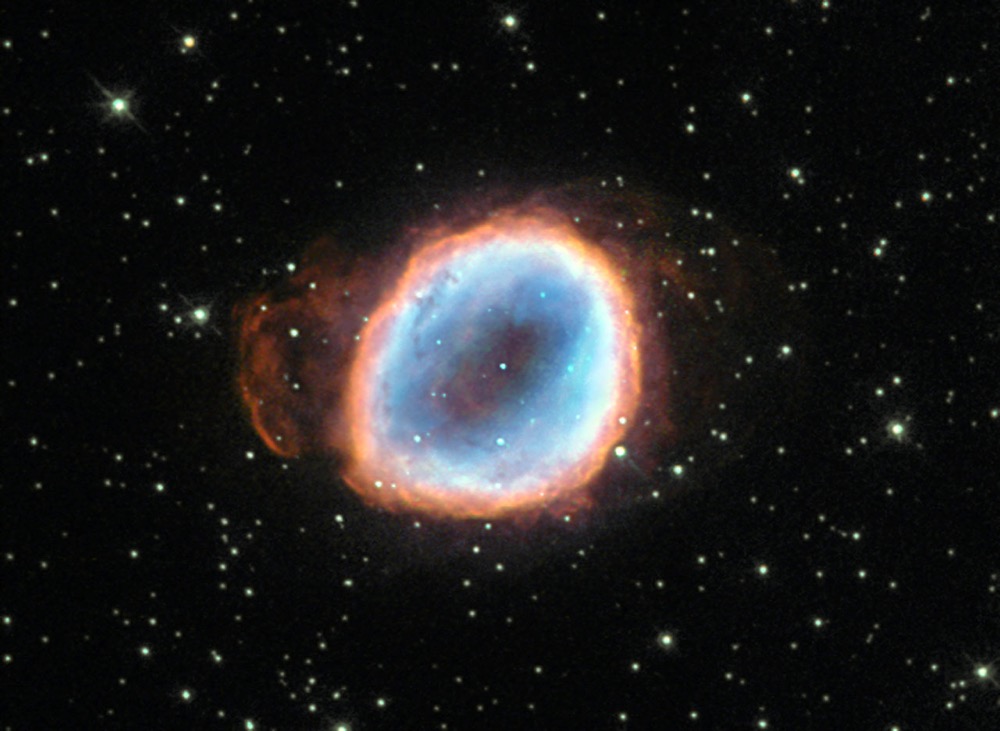
Somewhen, though, the hydrogen in the dominicus'due south outer core volition get depleted, and the sun will start to plummet once again, triggering another cycle of fusion. For almost 2 billion years the sun volition fuse helium into carbon and some oxygen, simply there's less energy in those reactions. Once the last bits of helium plow into heavier elements, in that location's no more than radiant free energy to continue the sun puffed up against it's own weight. The core will shrink into a white dwarf. The distended sun'south outer layers are just weakly leap to the core because they are so far away from it, so when the core collapses it will leave the outer layers of its atmosphere behind. The outcome is a planetary nebula.
Since white dwarfs are heated by compression rather than fusion, initially they are quite hot — surface temperatures can reach 50,000 degrees Fahrenheit (nearly 28,000 degrees Celsius) — and they illuminate the slowly expanding gas in the nebula. So any alien astronomers billions of years in the future might see something like the Ring Nebula in Lyra where the sun in one case shone.
Follow Life's Footling Mysteries on Twitter @llmysteries. We're also on Facebook & Google+.

Jesse Emspak is a contributing writer for Live Science, Infinite.com and Toms Guide. He focuses on physics, man health and general science. Jesse has a Master of Arts from the University of California, Berkeley School of Journalism, and a Bachelor of Arts from the University of Rochester. Jesse spent years covering finance and cut his teeth at local newspapers, working local politics and police beats. Jesse likes to stay active and holds a third degree black belt in Karate, which only means he now knows how much he has to larn.
Source: https://www.livescience.com/32879-what-happens-to-earth-when-sun-dies.html
0 Response to "What Will Happen to Humans When the Sun Dies"
Post a Comment